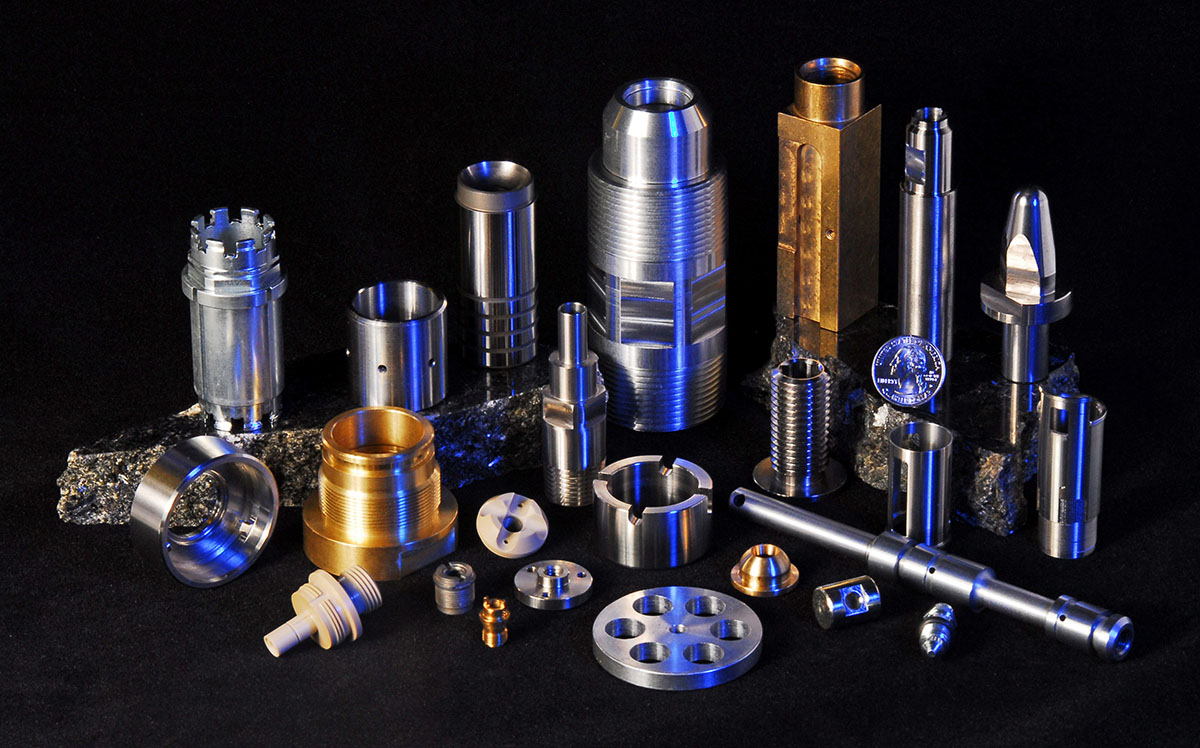

Material selection in CNC machining dictates how a component is cut, finished, and ultimately how it performs in service. Across aerospace, medical, electronics, heavy equipment, oil and gas, and automotive industries, four metals account for the majority of precision turned components: aluminum, stainless steel, brass, and titanium.
Sharp Turn Products machines these materials and produces tight-tolerance components for industrial OEMs throughout the United States.
Aluminum
Aluminum remains one of the most widely machined metals in CNC turning because of its usable strength and efficient machinability. Its high strength relative to its weight supports aerospace components, engine parts, and transportation hardware.
From a machining standpoint, aluminum generates lower cutting resistance than harder alloys. Higher spindle speeds are achievable, surface finishes remain consistent, and tool wear progresses at a manageable rate. It also responds well to secondary treatments such as anodizing, which enhances corrosion resistance and retains dimensional stability.
Stainless Steel
Stainless steel is specified for components exposed to moisture, pressure, or sustained mechanical load. Medical hardware, food service equipment, hydraulic systems, oil and gas fittings, and potable water applications specify stainless grades for corrosion resistance and strength.
Its higher tensile strength increases cutting forces and accelerates heat buildup at the tool edge. The material work-hardens as it is cut, which can make holding tight tolerances more difficult over longer runs. Stainless provides the benefit of long service life but entails tighter control during machining.
Brass
Brass is selected for components that involve electrical conductivity, precise thread geometry, or tight dimensional control. It appears in electronics assemblies, instrumentation hardware, semiconductor parts, and fluid system fittings for those properties.
Its machining behavior is stable and predictable. Threads and fine features hold their shape, and tool wear remains lower than with stainless or titanium alloys. Dimensional drift across extended runs remains limited, including on small-diameter and detail-intensive components.
Titanium
Titanium is selected for components that carry high loads, face corrosive exposure, and cannot tolerate excess mass. Aerospace structures, medical implants, defense components, and high-performance engine systems are typical examples.
During machining, titanium concentrates heat at the cutting interface rather than dissipating it through the chip. Tool life shortens quickly if feeds or speeds fall outside a controlled range. Once machined within stable parameters, titanium components endure prolonged load and corrosive exposure.
How These Materials Compare in CNC Machining
- Aluminum: supports higher spindle speeds, low cutting resistance, favorable strength relative to weight, and accepts anodizing.
- Stainless steel: corrosion resistance and structural durability in high-load and high-moisture conditions; higher cutting forces and work-hardening demand closer machining control.
- Brass: clean chip formation, consistent threading, low tool wear, and dimensional stability over repeat runs.
- Titanium: high strength-to-weight performance; low thermal conductivity concentrates heat at the cutting edge and requires controlled feeds and speeds.
Material selection affects how the part is machined, how often it is inspected, which finishes it can accept, and how it performs once installed.
Work With a CNC Machining Partner That Understands the Difference
Sharp Turn Products supports industrial OEMs nationwide with precision CNC machining in round, hex, and square bar stock from 1/4″ to 2″ diameter. Small quantities starting at 25 pieces are welcomed alongside larger production runs, with ISO 9001:2015-certified quality systems and advanced inspection processes ensuring consistency across materials.